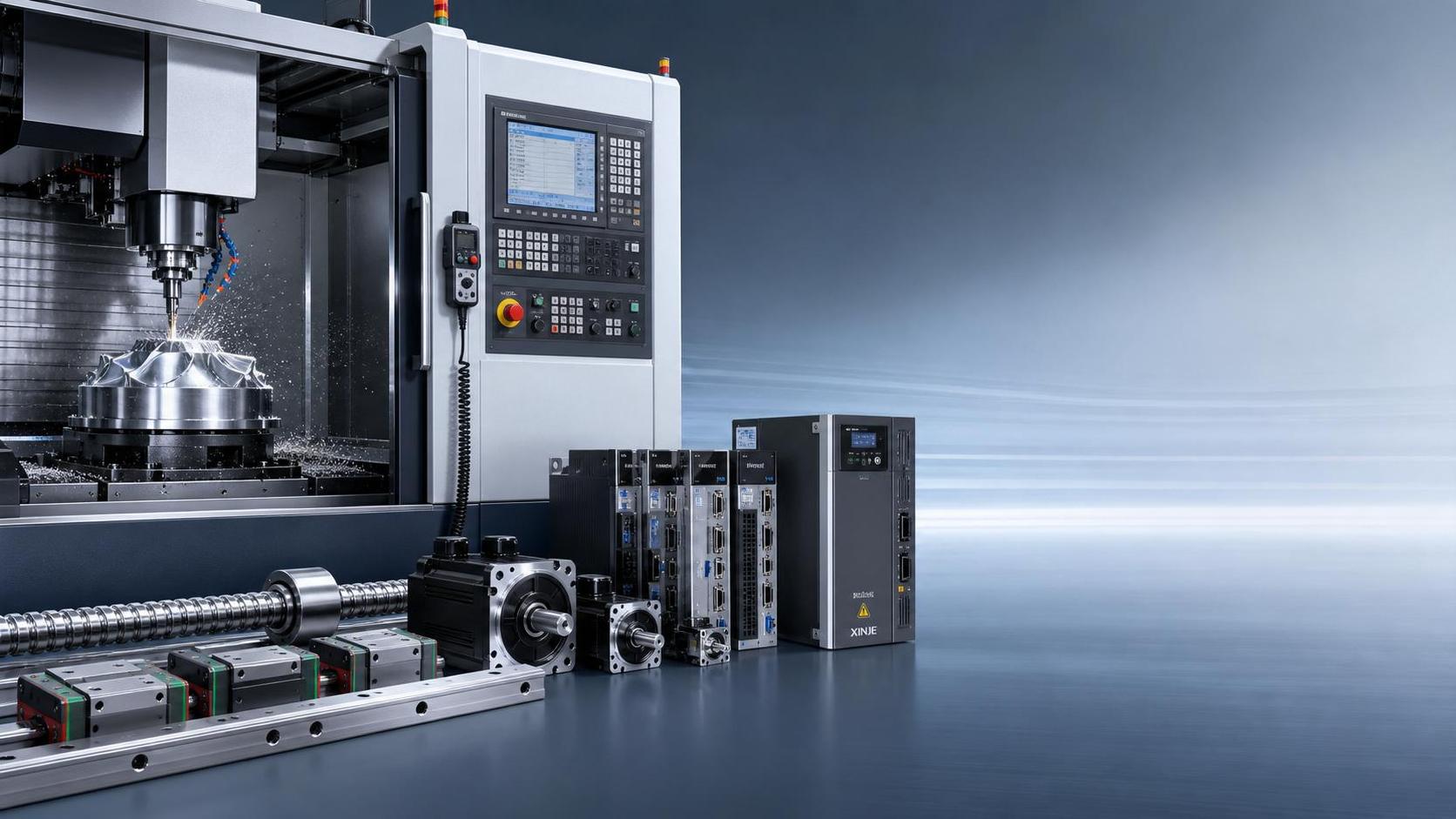
Motion Control Mistakes That Reduce Positioning Accuracy


Motion Control errors often hide in tuning, feedback alignment, mechanical backlash, and unstable loads—yet each one can quietly reduce positioning accuracy and machine reliability. For operators and end users, understanding these common mistakes is the first step toward smoother motion, tighter tolerances, and fewer production losses. This article highlights the practical issues that most often undermine precision and shows why small control details matter.
When positioning accuracy drops, many operators first suspect the servo motor, encoder, or controller. In practice, the real problem is often a combination of small Motion Control mistakes.
These mistakes usually appear in parameter setup, mechanical condition, feedback quality, and daily operation. Each issue may seem minor alone, but together they create repeatability loss, overshoot, drift, vibration, and scrap.
For end users and machine operators, the key question is not just “What is wrong?” but “What should I check first, and what has the biggest effect on accuracy?”
This article answers that directly. It focuses on the errors that most often reduce positioning performance, how they show up on the machine, and what practical checks can restore precision.
Why positioning accuracy problems are often not caused by one single fault
In real equipment, Motion Control accuracy depends on the full chain: command generation, controller response, servo tuning, mechanical transmission, load behavior, and feedback measurement.
If one part of that chain is unstable, the whole system suffers. A perfectly tuned drive cannot compensate for severe backlash, and a rigid mechanical system still fails if feedback scaling is wrong.
This is why operators should avoid changing one parameter after another without a structured check. Random adjustments often hide the root cause and make later troubleshooting harder.
A better approach is to separate the problem into four layers: command and settings, feedback and wiring, mechanics and transmission, and load or process conditions.
Once those layers are checked in order, positioning errors usually become easier to identify. The machine symptoms start to make more sense, and corrective action becomes more effective.
Common tuning mistakes that create overshoot, settling delay, and inconsistent stops
Improper servo tuning is one of the most common Motion Control mistakes. Many machines are left with factory-default gains, even though the actual load inertia and mechanical stiffness are very different.
When position loop gain is too low, the axis responds slowly and may stop short before correcting itself. This creates longer settling time and poor cycle consistency.
When gain is too high, the axis can overshoot the target, oscillate around the stop point, or generate audible vibration. Operators may see unstable final positions or notice increased wear.
Another frequent mistake is ignoring velocity loop tuning. Even if position commands look correct, poor velocity response can cause lag, hunting, or uneven movement during acceleration and deceleration.
Feedforward settings also matter. If feedforward is missing or badly adjusted, the axis may show following error during high-speed moves, especially on repetitive indexing tasks.
Operators should watch for clues such as sharp noise at stop points, long settle time before a process begins, or different stop quality at different speeds. These usually point to tuning issues.
Good tuning is not just about making the axis move fast. It is about balancing responsiveness, stability, repeatability, and mechanical stress under real production conditions.
Feedback alignment and scaling errors that quietly damage precision
Many positioning problems come from feedback mistakes rather than motor output problems. If the encoder, linear scale, or resolver signal is misaligned, inaccurate, or poorly scaled, the controller makes wrong corrections.
One common error is incorrect electronic gearing or pulse scaling. The axis may move, but the commanded distance and actual distance no longer match exactly.
This often appears as a repeatable dimensional deviation. The machine stops consistently, but not at the correct physical position. Operators may mistake this for backlash or tool offset issues.
Another problem is loose encoder coupling or unstable feedback mounting. In this case, position error may change with speed, direction, or load, making diagnosis more confusing.
Electrical noise can also corrupt feedback signals. In industrial environments with inverters, contactors, and poor grounding, feedback lines may pick up interference that causes jitter or false counts.
If the system uses both motor encoder feedback and external linear feedback, mismatch between the two sources can produce unstable compensation. This is especially important in precision stages and long-travel axes.
Operators should confirm scaling values, reference positions, homing behavior, and cable condition before changing motion gains. If the feedback is wrong, tuning will not solve the problem.
Mechanical backlash and coupling looseness that control software cannot fully fix
Mechanical transmission issues are among the most underestimated causes of poor Motion Control accuracy. Software can compensate for some lost motion, but it cannot eliminate all physical play.
Backlash in ball screws, gear reducers, couplings, and linkages often shows up during direction reversal. The axis seems accurate in one direction but inconsistent when moving back.
This leads to poor bidirectional repeatability. Hole patterns, pick-and-place alignment, or cut locations may drift depending on approach direction, even when encoder feedback appears normal.
Loose couplings create another hidden problem. The motor shaft turns immediately, but the load responds with a delay or elastic twist. The controller sees movement, yet the real load position lags.
Worn linear guides or poor lubrication can also increase friction variation. Instead of smooth travel, the axis experiences stick-slip behavior, especially at low speed or during small corrections.
Reducers add their own risks. Harmonic and planetary gear systems can suffer from torsional compliance, wear, or assembly misalignment, all of which affect final positioning under changing loads.
Operators should inspect couplings, mounting bolts, screw nuts, guide preload, lubrication condition, and transmission wear. These checks often reveal more than another round of parameter edits.
Ignoring load changes is a major reason accuracy degrades during production
An axis may perform well during setup but lose precision during actual production because the load is not stable. This is a very common field problem.
Load inertia can change when different products, grippers, fixtures, or workpiece weights are introduced. A tuning set that works for one job may become marginal for another.
Vertical axes face added challenges from gravity effects. If brake timing, torque bias, or gravity compensation is not correct, position holding and stop accuracy can suffer.
Cutting forces, pressing forces, winding tension, and material drag can all shift the load while the axis is moving. The controller then reacts to a condition it was not tuned for.
Some operators only test motion without process load, which gives a false sense of stability. Once the machine starts real work, following error and vibration suddenly appear.
The practical lesson is simple: Motion Control should be verified under actual operating conditions, not only in empty-cycle mode. Real loads expose weaknesses that idle tests hide.
If errors increase only during certain products or process stages, the issue is often load-related rather than purely electrical or mechanical. That pattern is an important diagnostic clue.
Homing and reference mistakes that shift every position afterward
Even a well-tuned system cannot position accurately if its home or reference point is wrong. A small homing error shifts every commanded position that follows.
This problem often appears after maintenance, sensor replacement, mechanical adjustment, or power cycling. Operators may notice that all positions are offset by a similar amount.
Home sensor repeatability matters more than many users expect. If the switch has poor consistency, contamination, or weak mounting, the reference point will vary from cycle to cycle.
Incorrect homing speed is another issue. Approaching the home point too fast can reduce repeatability, especially in systems that rely on sensor edge detection plus encoder marker capture.
Reference logic inside the PLC or motion controller also deserves attention. Unit conversion mistakes, offset entry errors, and wrong axis zero definitions can all create systematic position shifts.
Whenever a machine loses its origin unexpectedly, operators should verify homing quality before assuming a servo failure. Many “accuracy” complaints begin with a flawed reference routine.
Poor acceleration, jerk, and motion profile choices that shake the machine
Sometimes the axis reaches the target, but not smoothly enough to do so accurately. Motion profile design has a direct effect on precision, vibration, and settling behavior.
If acceleration is too aggressive, the mechanical structure may flex, resonate, or excite backlash zones. The final position may still be reached, but only after extra settling time.
High jerk values are especially problematic. Sudden changes in acceleration create shock loads that travel through screws, guides, frames, and tooling.
This can disturb sensors, loosen hardware over time, and amplify oscillation in lightly damped systems. Operators often describe the result as “the axis slams” or “it rings after stopping.”
Reducing top speed alone may not fix this. In many cases, smoother acceleration ramps and better jerk control improve positioning more than simply slowing the machine down.
For precision tasks, the best profile is often the one that minimizes structural excitation while still meeting takt time. Smooth motion is usually more accurate motion.
Electrical noise, grounding, and wiring issues that mimic control problems
Not every unstable axis has a bad tuning file. In many factories, electrical noise and wiring quality are major Motion Control risks.
Improper grounding can create intermittent encoder errors, communication dropouts, and analog signal drift. These problems may look like random positioning faults with no clear mechanical pattern.
Routing power cables too close to feedback cables is another classic mistake. Servo output, inverter switching, and braking circuits can inject interference into sensitive signal lines.
Loose terminals, damaged shielding, and poor connector locking can cause intermittent faults that appear only during vibration, high speed, or temperature change.
Networked motion systems add another layer of risk. If real-time communication is unstable, command timing may vary and axis coordination may degrade.
Operators should include cable inspection, shield continuity checks, grounding review, and cabinet cleanliness in regular maintenance. These basic actions can prevent expensive troubleshooting later.
Changing parameters without baseline data often makes things worse
One of the biggest operational mistakes is adjusting many Motion Control parameters before collecting evidence. This usually turns a manageable problem into a confusing one.
Before making changes, record the symptom clearly. Does the error occur only after direction reversal, only at high speed, only with load, or only after warm-up?
Check alarm history, following error trends, cycle timing, actual-versus-command position data, and maintenance records. Even simple observations can narrow the cause significantly.
If possible, change one variable at a time and verify the result. Random edits to gains, filters, compensation values, and offsets can hide the original fault pattern.
A useful field method is to compare current behavior with a known good baseline. If no baseline exists, create one now using repeatability checks, reference tests, and standard motion cycles.
Structured troubleshooting is faster than guesswork. It also reduces the chance of creating new instability while trying to solve an old problem.
A practical checklist operators can use before calling for major service
When positioning accuracy drops, start with the simplest high-impact checks. Confirm the machine is homing correctly and that the reference point repeats consistently.
Next, inspect visible mechanics: couplings, guide condition, screw lubrication, mounting bolts, and signs of wear or looseness. Listen for changes in sound during acceleration and stop.
Then review feedback health. Check encoder cables, connectors, scaling values, and whether actual travel matches commanded travel over a measured distance.
After that, compare performance with and without real process load. If the problem appears only under production conditions, focus on load variation, force disturbance, and profile settings.
Finally, review tuning and filters only after the previous checks are complete. A stable mechanical and feedback foundation is necessary before tuning can deliver real improvement.
This sequence saves time because it follows the most common field failure path. Many accuracy issues are found before advanced service intervention becomes necessary.
Conclusion: precise Motion Control depends on disciplined basics
Positioning accuracy rarely disappears for no reason. Most losses come from a small set of repeatable Motion Control mistakes: poor tuning, bad feedback setup, backlash, unstable loads, weak homing, harsh profiles, or electrical noise.
For operators and end users, the biggest advantage comes from recognizing these patterns early. Small errors in setup or maintenance can grow into scrap, downtime, and reduced machine confidence.
The good news is that many of these issues are practical to identify. A structured check of reference, mechanics, feedback, load condition, and tuning will solve more problems than random parameter changes.
In Motion Control, precision is rarely the result of one expensive component alone. It comes from the consistent alignment of control logic, feedback truth, mechanical integrity, and real operating conditions.
When those basics are managed well, machines stop more accurately, run more smoothly, and hold tighter tolerances with less effort. That is the foundation of reliable production precision.
Related Recommendations
 How Industrial Control Technology Solutions Cut Downtime in Mixed Automation LinesTime : Jul 15, 2026
- Smart Industrial Components for Packaging: Common Integration Mistakes to AvoidTime : Jul 14, 2026
- Motion Control Components for Packaging: How to Choose for Speed and StabilityTime : Jul 13, 2026
- CNC Control Software: Key Features That Improve Machining AccuracyTime : Jul 13, 2026
- PLC-DCS Integration Solutions for Brownfield Plant UpgradesTime : Jul 11, 2026
- Motion Control Technology for Machine Tools: Key Setup PrioritiesTime : Jul 10, 2026