Precision Robot Gearbox: Key Signs of Backlash and Wear

Precision Robot Gearbox: Key Signs of Backlash and Wear
When a precision robot gearbox starts showing backlash, vibration, or unstable positioning, the warning usually appears before a complete failure.
The challenge is catching those signs early, while the unit is still serviceable and production remains stable.
For industrial robots, even a small change inside a precision robot gearbox can affect path accuracy, cycle consistency, and repeatability.
That also means small gearbox defects can spread into larger servo, bearing, or alignment problems if they are ignored.
This article focuses on practical fault clues, field inspection priorities, and simple ways to separate normal aging from abnormal wear.
Why backlash matters in a precision robot gearbox
Backlash is the lost motion between input and output during reversal, and it is one of the clearest health indicators in a precision robot gearbox.
In robot joints, backlash directly affects pick accuracy, weld path quality, assembly fit, and smooth motion at low speed.
A gearbox with rising backlash may still run, but the robot often stops meeting positioning targets under real load.
From a maintenance view, backlash is rarely an isolated symptom.
It often comes with wear on gear teeth, flexspline fatigue, bearing damage, lubrication breakdown, or looseness in couplings and mounting points.
That is why a precision robot gearbox should be checked as part of the full motion chain, not as a standalone part.
Early signs that should not be ignored
Most gearbox failures give off subtle signals first.
The real issue is that these signals are often mistaken for servo tuning drift or program changes.
1. Positioning drift during reverse motion
A common first clue is extra deviation when the joint changes direction.
The robot may hit the target from one side, then miss slightly from the other.
This pattern strongly suggests growing backlash inside the precision robot gearbox or nearby mechanical interfaces.
2. New vibration at low speed
A worn precision robot gearbox often becomes more noticeable at crawl speed than at full speed.
Instead of smooth travel, the axis may show slight shudder, uneven feed, or intermittent stick-slip behavior.
That usually points to tooth wear, lubrication loss, or bearing roughness.
3. Rising noise during acceleration and deceleration
A healthy precision robot gearbox has a stable sound pattern.
When wear develops, the sound often changes first during speed transitions.
Listen for clicking, light knocking, or a rough rolling tone that repeats at consistent joint angles.
4. Torque demand starts climbing
Wear does not only create looseness.
In many cases, it also increases internal friction.
If servo current rises under the same payload and path, inspect the precision robot gearbox for drag, contamination, or bearing distress.
Practical inspection points in the field
A useful inspection routine should be fast, repeatable, and easy to compare over time.
In actual service work, these checkpoints usually reveal whether the precision robot gearbox is the source.
- Check output play at shutdown, especially during manual reversal around the zero-load region.
- Compare repeatability from clockwise and counterclockwise approach directions.
- Review servo current, following error, and vibration data under the same recipe.
- Inspect mounting bolts, couplings, key interfaces, and fixture rigidity before blaming the gearbox.
- Check lubricant condition for discoloration, metallic particles, separation, or dryness.
- Use temperature trend comparison across similar robots or matching axes.
These checks matter because gearbox symptoms often overlap with control issues.
A precision robot gearbox should be confirmed through combined evidence, not one isolated sound or one operator comment.
How to tell backlash from other faults
Not every accuracy problem comes from gearbox wear.
That distinction saves time and avoids unnecessary replacement.
The more angle-specific and direction-sensitive the symptom is, the more attention the precision robot gearbox deserves.
Common wear mechanisms inside a precision robot gearbox
Understanding the wear mode makes troubleshooting faster and more accurate.
Different reducer types fail differently, but several patterns appear again and again.
- Tooth surface wear from poor lubrication, contamination, or overload cycles.
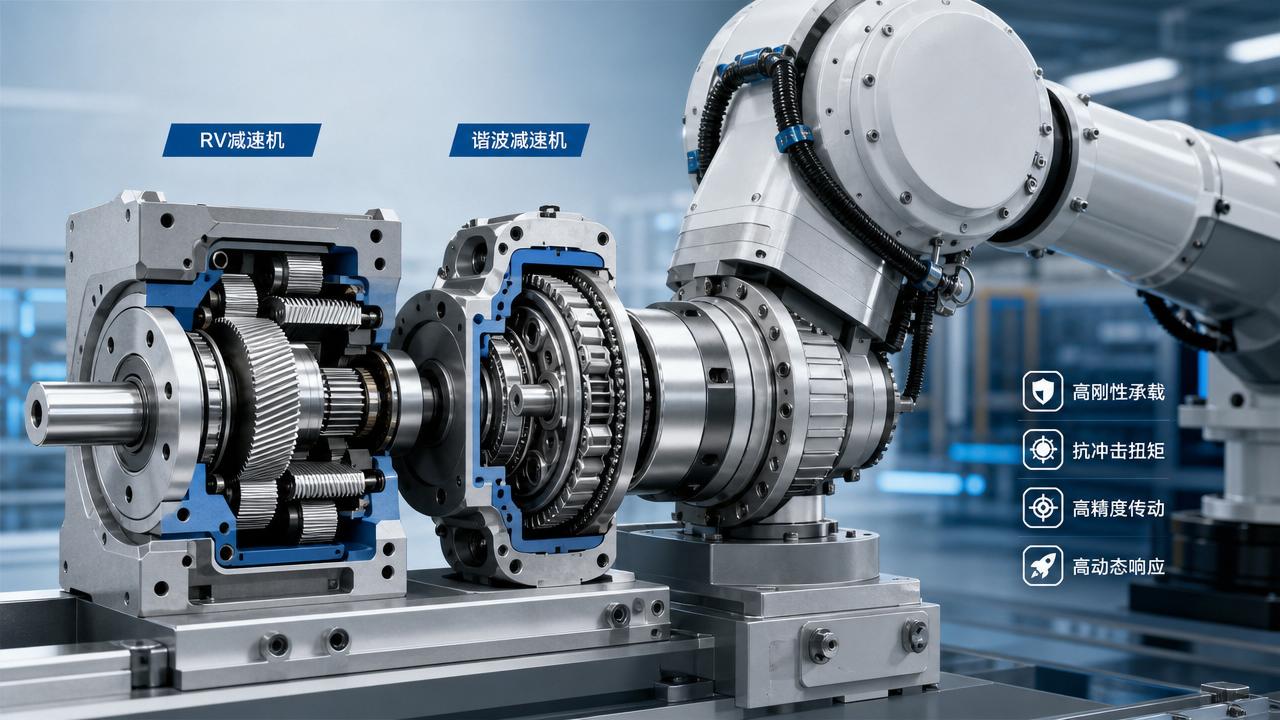
- Flexspline fatigue in harmonic units after high-cycle deformation.
- Bearing pitting or preload loss, leading to vibration and heat.
- Mounting distortion, which changes contact patterns inside the precision robot gearbox.
- Shock load damage from crashes, hard stops, or unstable payload handling.
In recent service cases, shock events are a frequent trigger.
The robot may continue running after a collision, but the precision robot gearbox often keeps a hidden accuracy loss.
What to do when wear is confirmed
Once wear is verified, the response should match the severity and production risk.
Running longer is not always the cheaper option.
- If backlash is slightly above baseline, increase inspection frequency and track trend data by shift or batch.
- If accuracy affects product quality, schedule gearbox replacement before process scrap rises.
- If heat, noise, and current all increase together, stop and inspect before secondary damage spreads.
- After replacement, recheck alignment, servo tuning, and repeatability to prevent false closure.
This is also where good records pay off.
A maintenance log showing current trend, noise change, and backlash growth makes future diagnosis much faster.
How to reduce repeat failures
A precision robot gearbox usually fails for a reason, not by accident.
Reducing repeat failures means controlling both the gearbox and the operating environment.
Focus on payload discipline, collision review, lubrication quality, sealing condition, and stable installation geometry.
It also helps to compare identical robots across the same line.
When one precision robot gearbox behaves differently from its peers, early intervention becomes much easier.
For organizations following industrial automation trends closely, this data-led approach fits the larger move toward predictive maintenance.
It connects mechanical condition, servo response, and production quality into one practical service decision.
Final takeaway
The most useful signs of a failing precision robot gearbox are rarely dramatic at first.
They usually appear as small reverse-motion error, low-speed vibration, unusual noise, and steadily rising torque demand.
When those clues are checked early, gearbox wear can be isolated before it turns into downtime, scrap, or repeated joint failure.
The practical next step is simple: inspect direction-change accuracy, verify mechanical play, review trend data, and act before the precision robot gearbox becomes the weak point in the robot cell.
Related Recommendations
 Robot Reducer Systems Supplier Comparison: Cost, Lead Time, and Service RiskTime : Jul 12, 2026
- Precision Robot Gearbox: Key Signs of Backlash and WearTime : Jul 11, 2026
- Robot Joint Reducers in Japan: What Is Shaping the 2026 Market?Time : Jul 08, 2026
- RV Reducers vs Harmonic Drives: Which Holds Up Better Under Shock LoadsTime : Jun 06, 2026
- Industrial Robotics Components Cost ChecklistTime : Jun 02, 2026